USGS updates “Volcano Observatory Notice to Aviation” alerts — USGS Volcano Watch
The Volcano Observatory Notice to Aviation (VONA) is a notification product used by volcano observatories globally to inform the aviation community (pilots, air traffic managers, dispatchers, meteorologists, and airlines) of volcanic activity that could pose a hazard to aviation. An upcoming change in message formatting will improve the way that the aviation community gets this information.
Within the United States, the USGS is designated by the Federal Aviation Administration as the entity to issue VONAs and has the responsibility to follow the content and format requirements established by the International Civil Aviation Organization.
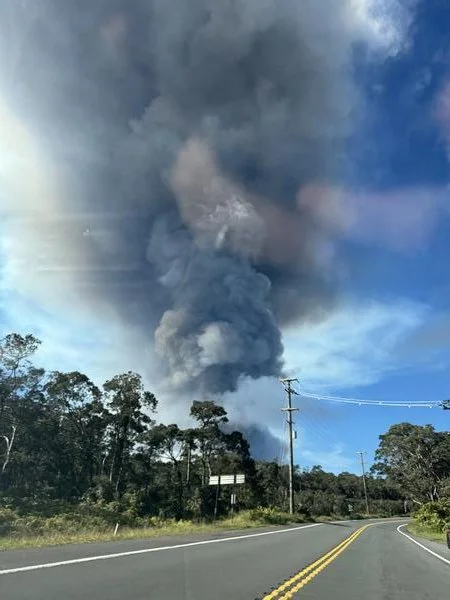
Sources/Usage: Public Domain.
An eruptive plume rises from the summit of Kīlauea volcano, visible from Highway 11 near Volcano Village on the Island of Hawaiʻi. This plume was generated during episode 38 of lava fountaining within Halemaʻumaʻu crater, which took place on December 6, 2025. USGS photo by K. Mulliken.
The VONA format has been updated to conform to aviation sector standards. The new format is machine-readable to allow it to be ingested into flight planning software used by airlines and distributed via the Aeronautical Fixed System of communication. It is not human friendly, as it is in all capital letters and uses aviation abbreviations, such as “VA” for volcanic ash. VONAs provide information that is important for aviation, such as the elevation of the volcanic plume above sea level (the plume includes ash and gas that can rise thousands of feet above a lava fountain) or the direction ash is being transported by the wind.
For everyone not in the aviation sector, the Volcanic Activity Notice (VAN) is the USGS notification product used to inform people on the ground of the volcanic activity that could pose a hazard on the ground. This is information specifically for partner response agencies, such as the Hawaiʻi County Civil Defense Agency and Hawaiʻi Volcanoes National Park, as well as Hawaiʻi residents and visitors.
In addition to providing information about what is going on at a volcano, VANs and VONAs include the Volcano Alert Level and Aviation Color Code System—a word or a color used to quickly to communicate the level of hazard at a volcano.
What is a hazard? It’s anything that is a potential source of danger. Volcanoes can have different hazards on the ground versus in the air, which is why this ranked system is two-tiered.
For hazards on the ground, the Volcano Alert Level uses terms to rank the volcano’s status.
NORMAL indicates the volcano is not erupting, and in a low-level background state of activity. ADVISORY means that there is some elevated activity (such as ground deformation or earthquakes) which could escalate to an eruption. WATCH is used when an eruption is likely, or an eruption is occurring with limited hazards, and WARNING means a hazardous eruption is imminent, underway, or suspected.
The Aviation Color Code focuses on the hazards for aviation, and it uses colors to rank the volcano status.
GREEN and YELLOW have the same definition as NORMAL and ADVISORY, while ORANGE (eruption likely or an eruption is occurring with no/minor ash) and RED (eruption with significant ash emission is imminent, underway, or suspected) are focused on whether there is a threat to aviation posed by volcanic ash.
A volcano can also be at an Alert Level or Aviation Color Code of UNASSIGNED, meaning that there is not enough monitoring data to assess the level of ground or aviation hazard.
In Hawaii, the Alert Level and Aviation Color Code of a volcano are often kept at the same level so-to-speak, but they can also be split depending on the conditions. For example, during the Mauna Loa 2022 eruption, the Volcano Alert Level was at the highest level of WARNING because a lava flow was encroaching on the Daniel K. Inouye Highway, while the Aviation Color Code was only at ORANGE because there was only minor ash emission. Kīlauea has been at WATCH/ORANGE for most of the ongoing summit eruption. However, the Aviation Color Code could be raised to RED in the future if the plume is high enough to potentially impact the aviation sector, and the Alert Level could be raised to WARNING in the future if there is the possibility of tephra fallout like what occurred during episode 41 on January 24, 2026.
You can subscribe to receive notifications from the Volcano Alert Level and Aviation Color Code System using the Volcano Notification Service (https://volcanoes.usgs.gov/vns/). The change in the VONA format means information will be provided to aviation in the same manner as other meteorological warning and forecast information. When the next Kīlauea fountaining episode begins, HVO will issue its very first VONA in the new format, and the aviation community will get that information more quickly and effectively than ever before.
Volcano Watch is a weekly article and activity update written by U.S. Geological Survey Hawaiian Volcano Observatory scientists and affiliates.