Hawaii Five-O! Fifty fountaining episodes at Kīlauea summit — USGS Volcano Watch
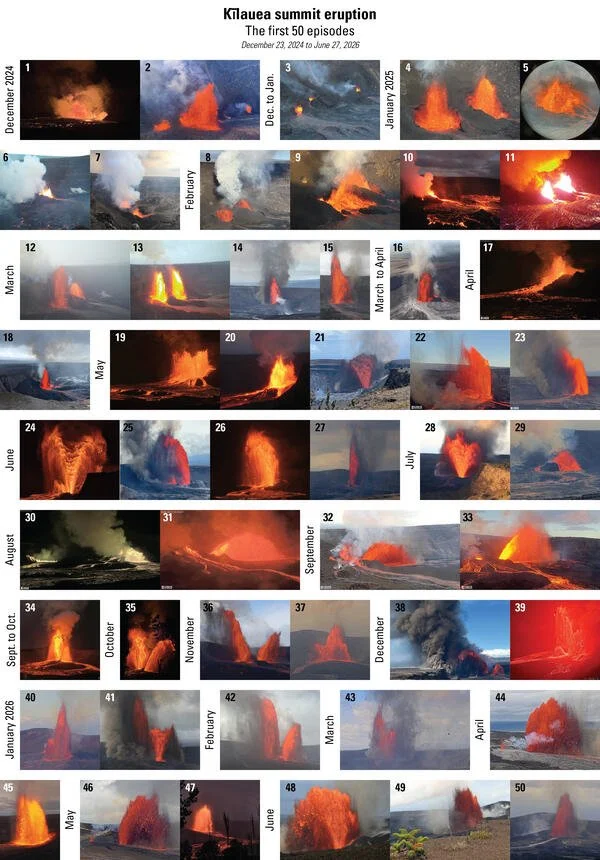
Hawaii, the 50th state, reached a golden anniversary last Saturday, June 27. Surprise, it’s the 50th fountaining episode of the ongoing episodic eruption in Halemaʻumaʻu at the summit of Kīlauea.
There was no celebratory cake, but the north vent served up a 1030 foot (314 meter) high lava fountain, the tallest since episode 43, to the delight of visitors to Hawaiʻi Volcanoes National Park and Kīlauea summit livestream/webcam watchers.
The weather was beautiful and the wind cooperated by blowing almost all of the tephra southward into remote parts of the National Park with only a trace dusting of Pele’s hair dropping over the town of Pāhala, 18 miles (30 km) to the southwest.
Sources/Usage: Public Domain.
Photo compilation of lava fountaining episodes 1–50 in the ongoing eruption at the summit of Kīlauea, including webcam imagery and photos taken by USGS Hawaiian Volcano Observatory scientists on the ground and during helicopter overflights. In all photos except for episode 7, the south vent is on the left and the north vent is on the right. For the episode 7 photo, the north vent is in the center and the south vent is below it to the right. The episode 5 photo only shows north vent. The episode 30 photo also shows a fissure on the south wall that was active in the first few hours of the episode. Since episode 44, only the north vent has produced lava fountains, although the south vent has produced spatter and/or lava overflows in the lead up to fountaining episodes.
The Halemaʻumaʻu eruption powered through the first 50 fountaining episodes in 551 days, averaging about 11 days between eruptions. The longest pause was just under 30 days and the shortest was less than one day. Similarly, the duration of the fountaining episodes has also shown a wide range averaging about 15 hours (0.6 days) with the longest lasting just over 140 hours (about 6 days) and the shortest 4.5 hours (0.2 days). The Pu‘u‘ō‘ō eruption currently holds the record for the longest fountaining episode at 12 days for episode 3, while the Kīlauea Iki eruption holds the record for the shortest fountaining episode duration at 1.75 hours.
The double fountains are another feature of this eruption that set it apart from previous episodic fountaining Hawaiian eruptions. Thirty-two of the 50 fountaining episodes in Halemaʻumaʻu have erupted double fountains. The north vent has surprisingly only sat out one episode (episode 17) while the south vent has taken 19 episodes off throughout the eruption, including the last 7 episodes. While it may seem that the south vent is taking it a bit easy, the Maunaulu eruption had the next most double fountains with a grand total of 4 episodes erupting lava fountains from both east and west vents.
The south vent has made up for its extended rest periods by producing the highest fountains of this eruption at 1770 feet (540 meters) during episode 43, the same maximum height recorded in episode 9 of the Maunaulu eruption (which had 12 total episodes). This falls short of Kīlauea Iki’s record breaking height of over 1900 feet (580 meters) during episode 16 (that eruption had 17 total episodes), but clearly tops Pu‘u‘ō‘ō’s highest fountains around 1525 feet (465 meters) in episode 29 (the Pu‘u‘ō‘ō eruption had 47 fountaining episodes before transitioning to continuous effusion of lava flows).
Another fact that may only be of interest to enthusiastic followers of the Halemaʻumaʻu eruption (and perhaps people that like statistics) is that the north vent has initiated the precursory activity that precedes the onset of fountaining episodes 90% of the time. USGS Hawaiian Volcano Observatory (HVO) scientists are still unsure what this means, but find it interesting that one vent, the north, has been so dominant in starting eruptive activity. There have been episodes (47 and 48) with precursory overflows exclusively from the south vent; however, during both of these episodes the south vent politely bowed out and let the north vent fountain.
The north vent also holds the record for the most precursory overflows in the episodes we have counted. Prior to episode 34, the north vent produced 114 overflows with none from the south vent. Episode 36 was preceded by the most overflows we have counted at 179, alternating between the north vent and south vent. The longest period of precursory overflows was 6 days preceding episode 44. The shortest was episode 17 when the south vent went directly into fountaining with no precursory overflows.
A good story needs to end with a bit of suspense, and this one leaves us all pondering a few questions. Will we see the south vent fountain again? Can the Kīlauea Iki high fountain record ever be broken? How much longer will this eruption go on? And, of course, what happens next after the fountaining episodes in Halemaʻumaʻu stop? If you’ve enjoyed getting caught up with Hawaii Five-O, know that HVO scientists are keeping a close watch out for any signs of a follow-up episode titled “Magma P.I.”
Volcano Watch is a weekly article and activity update written by U.S. Geological Survey Hawaiian Volcano Observatory scientists and affiliates.