Remembering a time when I forgot that Hawaii has earthquakes — USGS Volcano Watch
I am a seismologist at the USGS Hawaiian Volcano Observatory (HVO)—earthquakes are always on my mind. But this wasn’t always the case.
By any number of measures, Hawaiʻi nei is paradise. Growing up in Waimānalo on the island of Oʻahu, with picturesque sandy beaches stretching from Bellows to Makapuʻu, natural disasters were few and far between. Hurricane Iniki is the one that sticks out most when looking back at my childhood. Other than hurricanes, I don’t remember much else disrupting life as I knew it, including earthquakes.
Sources/Usage: Public Domain.
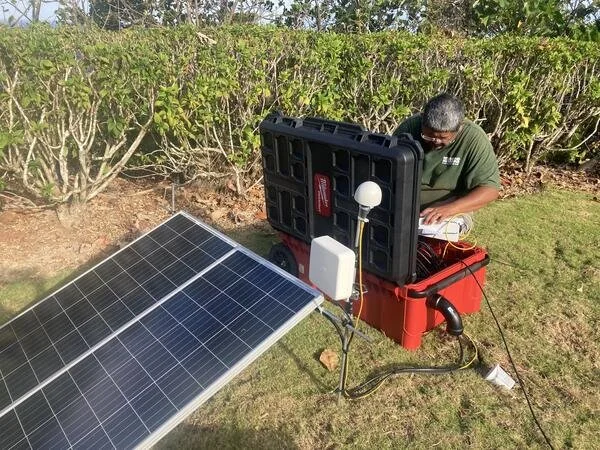
USGS Hawaiian Volcano Observatory seismic network manager Jefferson Chang installs a seismic station on Tutuila island in American Samoa in September 2022, in response to increased earthquake activity there. USGS photo by A. Ellis.
I knew I wanted to pursue a degree of some sort, so I went to Leeward Community College for a few years. Eventually, I moved to the continent and ended up studying geology. I know what you’re thinking, “rock are so amazing!” and I completely agree. But more so than looking at rocks, I enjoyed trying to figure out how rocks came to be, how they got to where they are, or how they moved to create mountains that span continents.
In Hawaii, we have basalt rocks; maybe a few more if you really get nerdy about it, but it’s mostly basalt. Around the world, there are many more kinds of rocks. I wanted to see all of them. I was looking at so many rocks that years came and went, and by the time I realized it, I was doing a doctoral degree in geophysics—more specifically, studying the processes of faulting (rocks breaking) and seismology (how the ground shakes). By this time in my life, I had written off living back home if I was to pursue a career in geoscience.
It wasn’t until I was waiting for a flight out of the San Francisco airport that I met a random person who asked if I was from Hawaii—which was pretty obvious because I almost always walk around in slippahs—that triggered a tectonic shift in my way of thinking about returning home. We got to talking, and this random person turned out to be Dr. Paul Okubo, former seismic network manager and research seismologist at HVO, now retired.
As soon as he mentioned he was from HVO, memories of my eight-grade field trip to the Big Island came flooding back. In a seismic snap, I remembered Hawaii has earthquakes.
Sources/Usage: Public Domain.
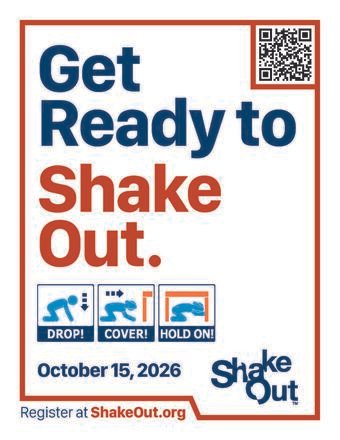
All Hawaii residents are encouraged to participate in the Great Hawaii ShakeOut earthquake drill at 10:15 a.m. on October 15, 2026. For more information, please visit https://shakeout.org/hawaii/ or the Hawaiian Volcano Observatory website (https://www.usgs.gov/observatories/hvo).
Because I grew up on Oʻahu—far from the typical epicenters of the Island of Hawaiʻi —earthquakes were rarely felt. I surely don’t remember feeling any from hanabada days. That chance meeting I had at San Francisco provided a beacon for me to find my way back home, while still doing what I love doing.
The fact that the Island of Hawaiʻi has active volcanoes means we have lots and lots of earthquakes. Most of these earthquakes aren’t strong enough to be felt, let alone be devastating. But, every once in a while, large earthquakes are produced, like the one earlier this year.
The magnitude-6 earthquake that nucleated under the west side of the Island of Hawaiʻi on May 22rd of this year was felt across the entire state. It is the most-reported earthquake to date— “Did You Feel It (DYFI)” reports came in from every populated island. Rockslides blocked roadways. Houses were damaged. Hundreds of homes lost electricity. A Federal Disaster was declared.
The magnitude-6 earthquake is a harsh reminder that we cannot forget about earthquakes.
We should always be thinking about earthquake preparedness. Yes, we should drop, cover, and hold-on as soon as earthquake shaking begins—this is a reactive drill. Beyond reacting to ground shaking, we can also take proactive steps in earthquake preparedness.
The Great Hawaiʻi ShakeOut webpage (https://www.shakeout.org/hawaii) has resources that show how anyone can be better prepared for the next big earthquake.
While on the ShakeOut webpage, you, or your ʻohana, community, or organization, can sign up to participate in the Great Hawaiʻi ShakeOut drill, which is a minute-long earthquake drill, held yearly on the third Thursday of October with the “earthquake” time depending on the date.
Join HVO next week Thursday, on 10/15 at 10:15 a.m., from wherever you may be across the Hawaiian Islands, as we practice what to do when the ground starts shaking: DROP, COVER, HOLD ON.
Volcano Watch is a weekly article and activity update written by U.S. Geological Survey Hawaiian Volcano Observatory scientists and affiliates. Today's article is written by HVO seismic network manager Jefferson Chang.