Kīlauea is all tied up at 47 episodes — USGS Volcano Watch
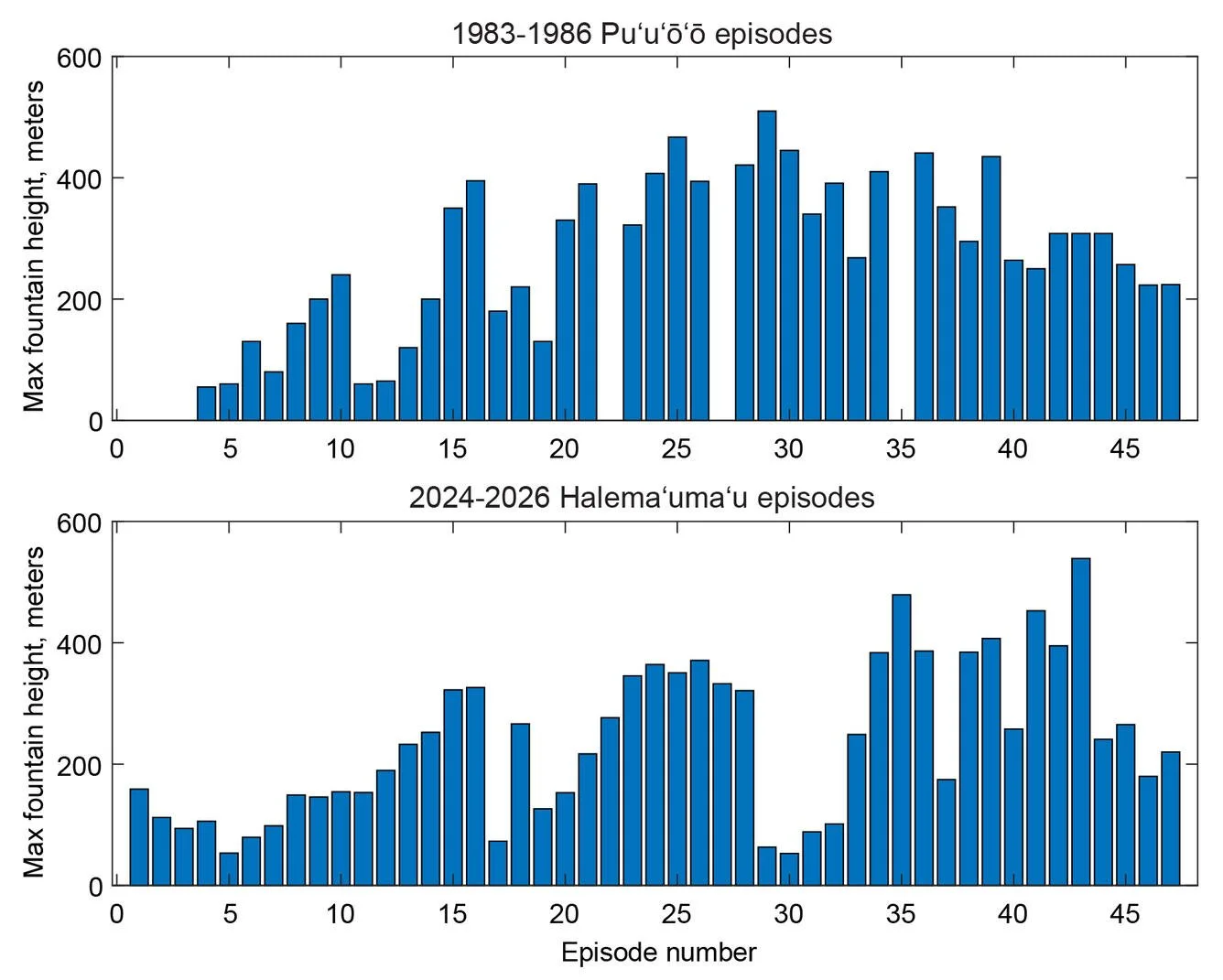
The lava fountains that erupted a week ago, on Thursday May 14, marked the 47th episode of the ongoing Halemaʻumaʻu eruption. This episode tied the 1983-1986 initial phase of the Pu‘u‘ō‘ō eruption, which had a total of 47 events, for the most fountaining episodes ever recorded at Kīlauea. Now that we’ve reached this milestone, let’s dig a bit deeper into how these historic eruptions compare.
Sources/Usage: Public Domain.
Comparison of the 1983–1986 Puʻuʻōʻō eruption lava fountain heights (top) with those of the 2024–ongoing Halemaʻumaʻu eruption (bottom). Note that the Puʻuʻōʻō measurements were made to the highest incandescent particle, whereas the measurements of the ongoing Halemaʻumaʻu eruption show the top of the main continuously incandescent lava fountain body. The comparison nevertheless shows the differing trends in fountain heights for each eruption. USGS plot.
Both eruptions produced spectacular high fountains, as did the 1959 Kīlauea Iki eruption with 17 episodes and the 1969-1970 Maunaulu eruption with 12 episodes. Similar high fountains were also associated with the 1960 Kapoho eruption, but this was driven by continuous draining of the summit reservoir at lower elevation versus the cyclic refilling that produces episodic eruptions higher on Kīlauea volcano.
The current Halemaʻumaʻu eruption is clearly a historic event providing the kind of close access to these classic Hawaiian fountain events not seen since the 1959 Kīlauea Iki eruption, which only lasted one month. Very few people got to see the Pu‘u‘ō‘ō fountains because of the eruption’s remote location in the middle of the East Rift Zone of Kīlauea.
Inevitably, the question always comes up “How does this eruption compare to past eruptions? Is it bigger, higher, longer?" These questions can be tricky to answer as eruptions differ in style and the way we collect data has changed over the past decades. Even though both the current Halemaʻumaʻu eruption and the initial part of the Pu‘u‘ō‘ō eruption reached 47 episodes, the current eruption took 1.5 years—more than twice as fast as the 3.5 years it took Pu‘u‘ō‘ō to reach the same mark. The average pause between episodes ranged from 24 days for Pu‘u‘ō‘ō, about 18 days for Maunaulu, 10 days for the ongoing Halemaʻumaʻu eruption, to a remarkable 2 days between Kīlauea Iki fountain events.
The magma supply rate for the Pu‘u‘ō‘ō eruption was about 4.6 cubic yards per second (yds3/sec) or 3.5 cubic meters per second (m3/sec), similar to the long-term supply rate from the hotspot to Kīlauea volcano. The preliminary supply rate for the Halemaʻumaʻu eruption is about 5.8 yds3/sec (4.4 m3/sec) or 25% more than the long-term supply rate. The Kīlauea Iki eruption has long been known to have been fed by an unusual pulse of magma from deep that averaged a little over 20 yds3/sec (15 m3/sec), about five times the long-term average supply rate.
Sources/Usage: Public Domain.
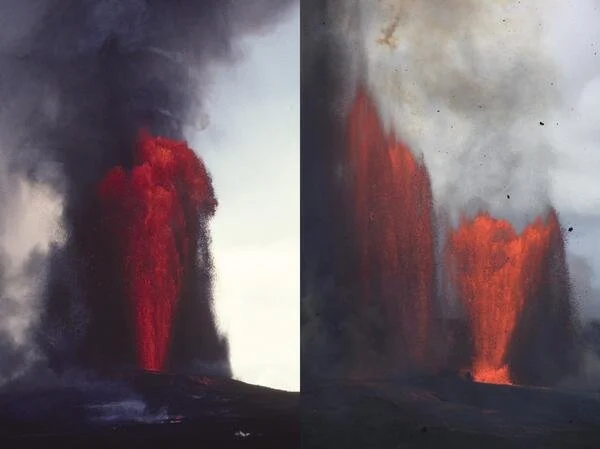
Left: Lava fountains on January 1, 1985, during episode 29 of the Puʻuʻōʻō eruption on the middle East Rift Zone of Kīlauea. Right: Lava fountains on January 24, 2026, during episode 41 of the Halemaʻumaʻu eruption. Episode 29 of the Puʻuʻōʻō eruption and episode 41 of the Halemaʻumaʻu featured the second-highest lava fountains in these eruptions (to date for the Halemaʻumaʻu eruption). USGS photos.
Height is another way to compare these eruptions (naturally). Currently, Kīlauea Iki holds the record of just over 1,900 feet (ft) or 580 meters (m) for the highest fountain. The record fountain height was short-lived and lasted only about 10 minutes. How fountain height is measured matters, though. During the Pu‘u‘ō‘ō eruption, scientists measured the highest wisps of incandescent lava, while we have been measuring the maximum height of the sustained, dense fountains in Halemaʻumaʻu, which can be several hundred feet lower than the wisps.
Whether or not the Halemaʻumaʻu eruption has produced a fountain greater in height than the Kīlauea Iki eruption will take some dedicated sleuthing. However, episode 43 produced a 1,770 ft (540 m) fountain from the south vent and a 1440 ft (440 m) fountain from the north vent, a truly magnificent spectacle not seen in prior eruptions. More than half of the Halemaʻumaʻu episodes have had dual fountains, which sets this eruption apart.
The episodic high fountaining of Pu‘u‘ō‘ō built a towering cone over 800 ft (250 m) high that was visible from Hilo and unlike any other vent ever described on Kīlauea or Mauna Loa volcanoes. This landmark was short-lived and by the 1990s was being incrementally swallowed into its own vent system, explaining why there were no others. The current Halemaʻumaʻu eruption has built a cone whose peak has added 150 ft (46 m) to the elevation of the crater rim, making it about equal in elevation above sea level to the peak of Puʻupuʻai, the cinder cone built by the 1959 eruption. However, the vent height has built up more than 500 ft (160 m) from the floor of Halemaʻumaʻu crater where it began in December 2024.
The ongoing summit eruption is already an event for the history books, and has garnered worldwide attention due to its visibility and access. No doubt, years from now, today's kids will be telling their grandchildren about these fountains.
Volcano Watch is a weekly article and activity update written by U.S. Geological Survey Hawaiian Volcano Observatory scientists and affiliates.